
Achievement Is Only One Part of the Student’s Journey

Attendance Is the First Signal Leaders Can’t Afford to Ignore
In education, achievement often takes center stage. Graduation rates, assessment outcomes, and readiness indicators dominate end-of-year conversations. While these measures matter, they are inherently retrospective. By the time outcomes are finalized, opportunities to intervene have often passed.
The most influential signals appear much earlier.
Attendance is one of the earliest and most reliable indicators of student risk. It rarely declines all at once. Instead, it shifts gradually: a few missed days, recurring absences around long weekends, or a student who remains enrolled but increasingly disconnected. Long before attendance becomes a formal concern, underlying challenges, academic disengagement, family instability, unmet needs, are often already present.
Surrounded by information, yet leaders are still struggling to answer timely questions: What’s changing right now? Where should we focus this week? Which students may need support before patterns solidify? When attendance data lives in static reports or complex dashboards, its role as an early signal is diminished.
What leaders need is not more data, but clearer signals, delivered consistently, at the right moment, and framed for action.
ion Brings Clarity in a Snapshot
To help leaders cut through the noise, ion Education delivers weekly attendance briefs that surface what matters most, quickly and consistently. These briefs are generated automatically and sent directly to leaders’ inboxes, creating a shared, timely view of attendance
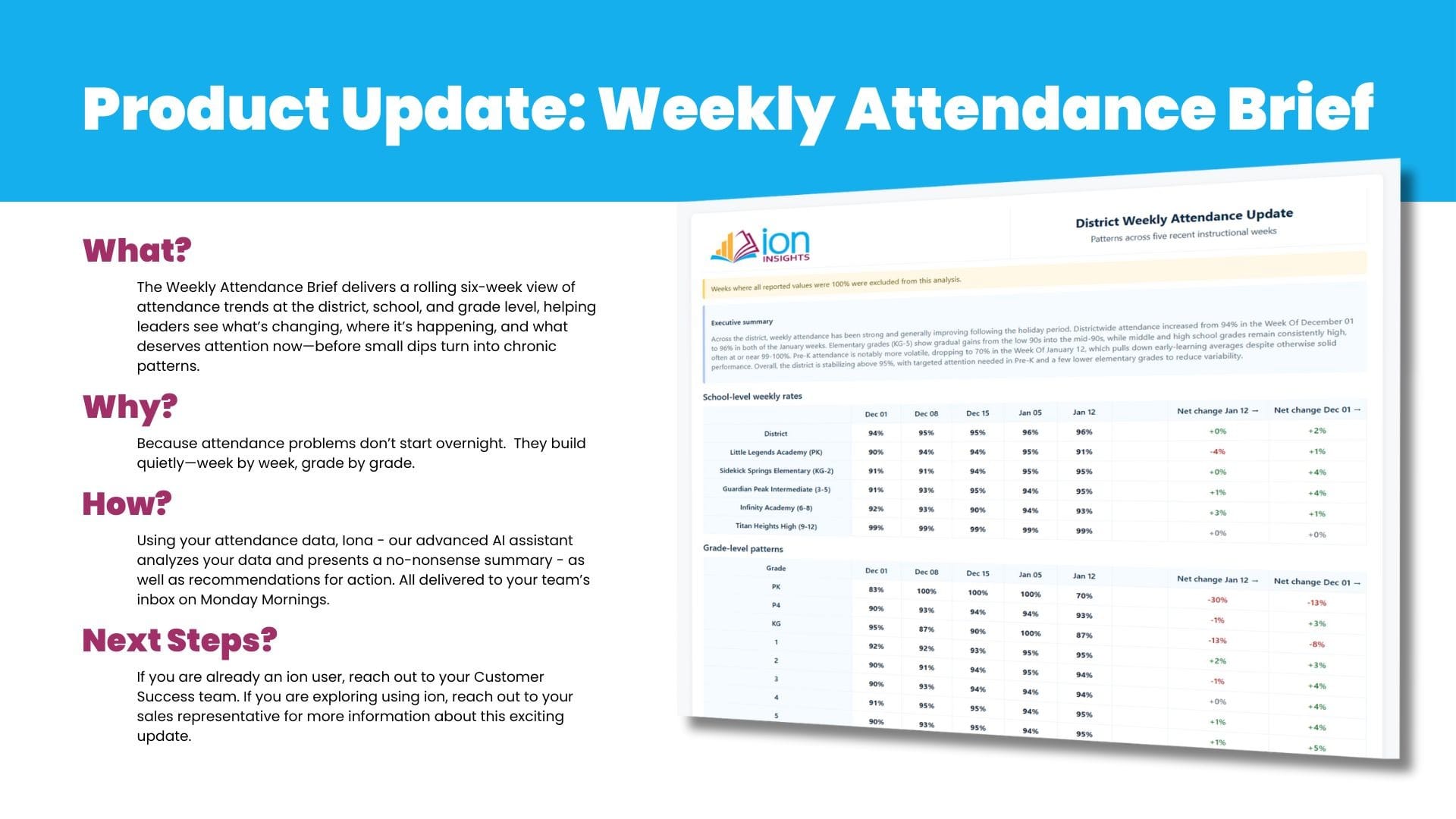
across the district.
Each brief provides a six-week snapshot of attendance trends, broken down week by week and grade by grade. Instead of navigating dashboards or waiting for formal reports, teams can immediately see where attendance is stable, where it is shifting, and where early attention may be needed.
Behind the scenes, ion’s AI assistant, Iona, analyzes attendance data to identify emerging patterns and provide context. The brief goes beyond describing what is happening, it highlights what may require action next and offers practical recommendations leaders can implement right away.
By translating complex data into a concise weekly narrative, ion supports informed decision-making without adding to leaders’ workload.
Daily Visibility: Keeps Students Within Reach
Daily review creates immediacy. It allows leaders to see changes as they occur, rather than after they accumulate. This level of visibility helps schools notice when something is off before it becomes routine and enables timely conversations among teachers, counselors, administrators, and families, while students are still reachable and schedules remain flexible.
Weekly Oversight: Revealing Patterns and Trends
Weekly monitoring adds comprehension. It helps leaders move beyond individual absences to identify patterns that warrant attention. At this cadence, teams can distinguish between short-term disruptions and emerging drift, responding with support rather than consequence.
Regular weekly review builds consistency in how attendance is discussed and addressed across schools.
Monthly Insight: Guiding Strategic Leadership Decisions
Monthly analysis provides perspective. It allows leaders to evaluate whether strategies are working, whether interventions are reaching the intended students, and how attendance trends align with academic and behavioral data. Monthly views connect day-to-day decisions to longer-term goals, anchoring leadership conversations in evidence.
Even with these layers of review, many districts experience a familiar challenge: information overload without clear direction. Daily data can feel too granular, while quarterly reports arrive too late to influence outcomes.
The challenge is not access, it is interpretation.
A Six-Week View That Drives Results
This is where the six-week attendance summary becomes essential.
Six weeks is a meaningful window in a student’s experience. It’s long enough for trends to emerge and short enough for leaders to intervene while change is still possible. Within this span, districts can identify students trending toward chronic absenteeism before thresholds are met, assess whether initiatives are gaining traction, and surface disparities early.
More importantly, a six-week view creates coherence. It transforms isolated data points into a shared narrative that leaders can understand, discuss, and act upon across schools and departments.
When leaders enter meetings with this level of clarity, the conversation shifts. Instead of asking, “What happened?” they ask, “What’s changing?” and “What do we do next?” With ion’s briefs, recommendations are immediately available, turning attendance into a forward-looking indicator rather than a backward explanation.
Attendance as a Window Into Student Success
Attendance is rarely just about attendance. It reflects engagement, access to resources, family circumstances, and a system’s ability to respond to barriers as they emerge. When leaders review attendance thoughtfully and consistently, they gain insight into the broader health of their district.
Effective attendance monitoring is not about compliance alone. It is about leadership awareness, recognizing that the earliest signs of risk are also the greatest opportunities for impact.
The most effective districts do not wait for problems to become unavoidable. They pay attention as the story unfolds, pause regularly to interpret what the data is signaling, and act while there is still time to influence the outcome.
Viewed through the right lens and at the right cadence, attendance is more than a metric. It is one of the most powerful tools leaders have to shape student success before outcomes are set.
Take Action Now
The districts making the greatest impact don’t wait for attendance challenges to escalate. They act when the signals first appear.
If you’re already an ion user, connect with your Customer Success team to learn more about weekly attendance briefs. If you’re exploring ion, let’s schedule a quick conversation to see how these insights can help your district act faster and more strategically.